Calorie Calculator
Calculate your daily calorie needs
Your BMR
Basal Metabolic Rate
BMI
--
How It Works
1. Calculate BMR using Mifflin-St Jeor formula
2. Multiply BMR by activity level factor
3. Result = Daily Calorie Needs (TDEE)
How to Calculate Your Daily Calorie Needs
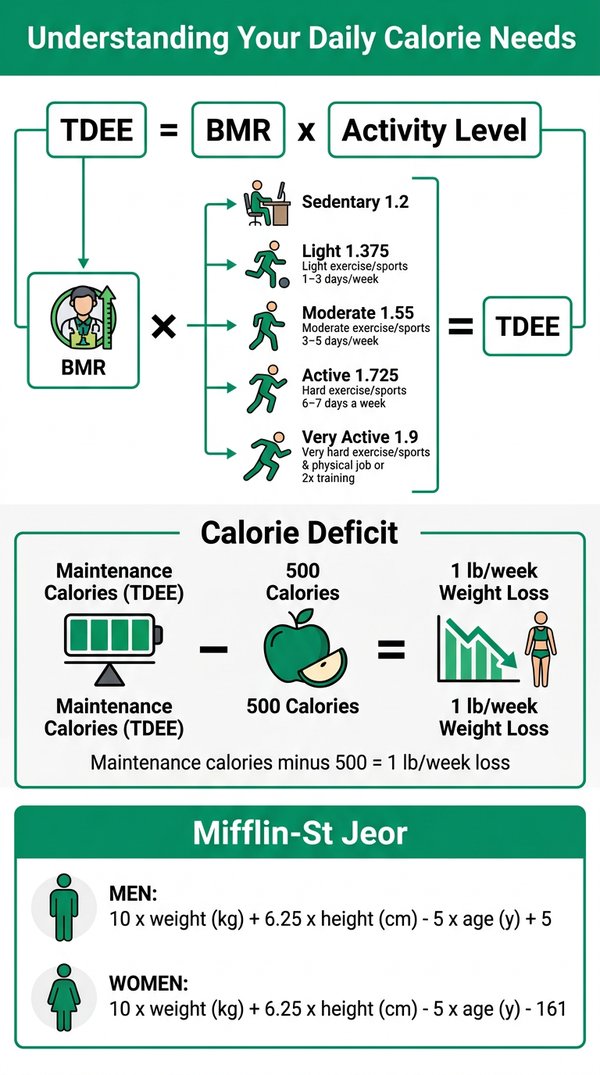
Your Total Daily Energy Expenditure (TDEE) is the number of calories you burn per day, including physical activity. This calculator uses the Mifflin-St Jeor equation, widely considered the most accurate formula for estimating calorie needs.
The Mifflin-St Jeor formula:
Men: BMR = 10 x weight(kg) + 6.25 x height(cm) - 5 x age - 5 + 5
Women: BMR = 10 x weight(kg) + 6.25 x height(cm) - 5 x age - 5 - 161
Your BMR (Basal Metabolic Rate) is then multiplied by an activity factor to determine TDEE:
- Sedentary (little/no exercise): BMR x 1.2
- Lightly active (1-3 days/week): BMR x 1.375
- Moderately active (3-5 days/week): BMR x 1.55
- Very active (6-7 days/week): BMR x 1.725
- Extra active (physical job/training): BMR x 1.9
Frequently Asked Questions
How many calories should I eat to lose weight?
To lose weight safely, create a calorie deficit of 500-750 calories per day below your TDEE. This typically results in 1-1.5 pounds of weight loss per week. Never eat below 1,200 calories/day for women or 1,500 for men without medical supervision, as very low calorie intake can slow your metabolism and cause nutritional deficiencies.
What is BMR and how is it different from TDEE?
BMR (Basal Metabolic Rate) is the calories your body burns at rest to maintain basic functions like breathing, circulation, and cell production. TDEE (Total Daily Energy Expenditure) includes your BMR plus all additional calories burned through daily activities and exercise. TDEE gives you the full picture of your daily calorie needs.
How accurate is the Mifflin-St Jeor equation?
The Mifflin-St Jeor equation is considered the most accurate BMR formula available, predicting resting metabolic rate within about 10% for most adults. However, it may be less accurate for athletes, elderly individuals, or those with certain medical conditions. For best results, combine the estimate with tracking your actual weight changes over time.
How many calories do I need to maintain my weight?
Your maintenance calories equal your TDEE — the total number of calories you burn per day. If you eat at your TDEE, your weight should remain stable. This varies based on age, sex, weight, height, and activity level. Use the calculator above with the "Maintain Weight" option to find your specific number.
What is a safe calorie deficit for weight loss?
A deficit of 500-750 calories per day is generally considered safe and sustainable, leading to 1-1.5 pounds of loss per week. Larger deficits may cause muscle loss, nutrient deficiencies, and metabolic slowdown. The safest approach is combining a moderate calorie deficit with regular exercise for a balanced weight loss plan.
Does exercise change my daily calorie needs?
Yes, exercise significantly impacts your calorie needs. Your activity level multiplier can change your TDEE by 20-90% above your BMR. For example, a sedentary person might need 1,800 calories/day while the same person exercising 6-7 days/week might need 2,600. That is why choosing the correct activity level is crucial for an accurate estimate.
Complete Guide to Understanding Calories and Your Daily Needs
What Are Calories?
A calorie is a unit of energy. In nutrition, one calorie (actually a kilocalorie or kcal) equals the amount of energy needed to raise the temperature of 1 kilogram of water by 1 degree Celsius. Your body uses calories from food to fuel everything from basic cellular functions to intense physical exercise.
Understanding your calorie needs is the foundation of any successful weight management plan. Whether you want to lose weight, gain muscle, or maintain your current size, knowing how many calories your body requires helps you make informed dietary choices.
How Your Body Uses Calories
Your body burns calories through three main processes:
1. Basal Metabolic Rate (BMR) - 60-70% of total: Calories burned at rest for vital functions like breathing, circulation, brain function, and cell production. This is your largest calorie expenditure.
2. Thermic Effect of Food (TEF) - 10%: Calories burned digesting and processing food. Protein has the highest TEF (20-30%), meaning you burn more calories digesting protein than carbs (5-10%) or fat (0-3%).
3. Physical Activity - 20-30%: Calories burned through exercise (running, weightlifting) and non-exercise activity (walking, fidgeting, standing). This is the most variable component and the one you can control most directly.
Understanding BMR vs TDEE
BMR (Basal Metabolic Rate) represents the minimum calories your body needs to survive while at complete rest. Think of it as your body's "idle" energy consumption — what you'd burn lying in bed all day doing nothing.
TDEE (Total Daily Energy Expenditure) is your BMR plus all additional calories burned through daily activities, exercise, and food digestion. TDEE is the number that matters for planning your diet.
Key Formula: TDEE = BMR × Activity Factor
Your activity factor ranges from 1.2 (sedentary) to 1.9 (extremely active). Choosing the right factor is crucial for accuracy.
Activity Level Multipliers Explained
| Activity Level | Multiplier | Description |
|---|---|---|
| Sedentary | 1.2 | Desk job, little/no exercise |
| Lightly Active | 1.375 | Light exercise 1-3 days/week |
| Moderately Active | 1.55 | Moderate exercise 3-5 days/week |
| Very Active | 1.725 | Hard exercise 6-7 days/week |
| Extra Active | 1.9 | Very hard exercise & physical job |
Calorie Calculation Examples and Real-Life Scenarios
Case Study 1: Office Worker Looking to Lose Weight
Profile: Sarah, 35 years old, female, 165 cm, 75 kg, sedentary job (works at desk 8 hours/day)
Step-by-Step Calculation:
BMR: (10 × 75) + (6.25 × 165) - (5 × 35) - 161 = 750 + 1031.25 - 175 - 161 = 1,445 cal/day
TDEE: 1,445 × 1.2 (sedentary) = 1,734 cal/day
Weight Loss: 1,734 - 500 = 1,234 cal/day (for ~0.5 kg/week loss)
Recommendation: Sarah should eat around 1,300-1,400 calories/day for sustainable weight loss. Going below 1,200 could slow her metabolism. Adding 30 minutes of walking 3x/week would increase her activity factor and accelerate results.
Case Study 2: Athlete Wanting to Gain Muscle
Profile: Mike, 25 years old, male, 180 cm, 70 kg, very active (trains 6 days/week)
Calculation:
BMR: (10 × 70) + (6.25 × 180) - (5 × 25) + 5 = 700 + 1125 - 125 + 5 = 1,705 cal/day
TDEE: 1,705 × 1.725 (very active) = 2,941 cal/day
Muscle Gain: 2,941 + 300 = 3,241 cal/day (for lean bulk)
Recommendation: Mike needs a slight surplus of 300-500 calories above TDEE for lean muscle gain. His macros should be: high protein (2g/kg = 140g), moderate carbs (for energy), and healthy fats (for hormones). Gaining 0.25-0.5 kg/week is ideal for minimizing fat gain.
Case Study 3: Middle-Aged Person Becoming More Active
Profile: John, 50 years old, male, 175 cm, 90 kg, was sedentary, now walking 4 days/week
Calculation:
BMR: (10 × 90) + (6.25 × 175) - (5 × 50) + 5 = 900 + 1093.75 - 250 + 5 = 1,749 cal/day
TDEE: 1,749 × 1.375 (lightly active) = 2,405 cal/day
Weight Loss: 2,405 - 500 = 1,905 cal/day
Key Insight: When John was sedentary, his TDEE was only 2,099. By increasing activity, he now burns 306 more calories/day without changing his diet. Combined with a moderate calorie deficit, this creates a powerful weight loss strategy. As he loses weight, his BMR will decrease slightly, requiring periodic recalculations.
Expert Tips for Managing Your Daily Calorie Intake
Tip 1: Track Your Food Intake
Most people underestimate their calorie intake by 30-50%. Use a food tracking app for at least 1-2 weeks to learn actual portion sizes and calorie content.
Action: Weigh and measure food for accuracy. "Eyeballing" portions leads to significant underestimation.
Tip 2: Prioritize Protein
Protein keeps you full longer (highest satiety), preserves muscle during weight loss, and has the highest thermic effect (20-30% of protein calories are burned during digestion).
Target: 1.6-2.2g protein per kg of body weight for active individuals.
Tip 3: Recalculate Every 4-6 Weeks
As you lose or gain weight, your BMR changes. Recalculate your calorie needs every 4-6 weeks or every 5 kg change to stay on track.
Rule of thumb: Every kg lost reduces BMR by ~10-15 cal/day.
Tip 4: Don't Eat Back Exercise Calories
Fitness trackers often overestimate calories burned during exercise. If you're using your TDEE with activity level, exercise calories are already factored in. Adding them back can erase your deficit.
Example: Tracker says you burned 400 cal running. Actual may be 250-300. Don't eat the "bonus" if weight loss is your goal.
Tip 5: Use the 80/20 Rule
Eat 80% whole, nutrient-dense foods (vegetables, fruits, lean protein, whole grains) and allow 20% for foods you enjoy. This prevents binge eating and makes your diet sustainable long-term.
At 1,800 cal: 1,440 cal from whole foods, 360 cal flexible.
Tip 6: Watch Liquid Calories
Sodas, juices, specialty coffees, and alcohol add up fast without making you feel full. A single Frappuccino can be 400-500 calories — nearly a full meal.
Strategy: Drink water, black coffee, or tea. Save liquid calories for post-workout recovery shakes with purpose.
Common Calorie Calculation Mistakes to Avoid
Mistake 1: Overestimating Activity Level
Wrong: "I walk to the kitchen a few times and do light housework, so I'm 'lightly active'."
Right: "Lightly active" means structured exercise 1-3 days/week (30+ min sessions). Desk work + light chores = sedentary (1.2). Be honest — overestimating by one level adds 200-300 calories to your target, preventing weight loss.
Mistake 2: Ignoring Weekend Eating
Wrong: Eating 1,500 cal Monday-Friday, then 2,500+ cal Saturday-Sunday.
Right: Weekly average: (1,500 × 5) + (2,500 × 2) = 12,500 cal/week = 1,786 cal/day average. Your weekend surplus can erase your weekday deficit. Plan for moderate weekend meals or budget calories ahead.
Mistake 3: Not Accounting for Cooking Oil and Condiments
Wrong: Tracking chicken breast (165 cal) but forgetting the 2 tablespoons of olive oil used to cook it (240 cal).
Right: Track everything: cooking oils (120 cal/tbsp), sauces, dressings, butter, and condiments. These "hidden" calories can add 300-500 cal/day to untracked diets.
Mistake 4: Eating Too Few Calories
Wrong: "I'll eat 800 cal/day to lose weight faster."
Right: Very low calorie diets (<1,200 for women, <1,500 for men) trigger adaptive thermogenesis — your BMR drops to conserve energy. You'll lose weight initially, then plateau, then regain rapidly when you resume normal eating. Aim for 500-750 cal deficit, not 1,000+.
Mistake 5: Trusting Food Labels Blindly
Wrong: Assuming "100 calories per serving" is exact.
Right: FDA allows ±20% variance on food labels. A "100 calorie" bar could actually contain 120 calories. Restaurant nutrition info is often 10-30% underestimated. Use labels as guides, not absolutes, and adjust based on actual weight changes.
Mistake 6: Forgetting That TDEE Changes With Weight
Wrong: "My TDEE was 2,200 when I started, so I'll keep eating 1,700 forever."
Right: A 70 kg person has a lower BMR than a 90 kg person. As you lose weight, recalculate. Someone who drops from 90 kg to 75 kg may see their TDEE drop from 2,400 to 2,100 — requiring a diet adjustment to continue losing.
Frequently Asked Questions About Daily Calorie Needs
1. How many calories should I eat to lose weight?
To lose weight safely, create a calorie deficit of 500-750 calories per day below your TDEE. This typically results in 0.5-0.75 kg (1-1.5 pounds) of weight loss per week. Never eat below 1,200 calories/day for women or 1,500 for men without medical supervision, as very low calorie intake can slow your metabolism and cause nutritional deficiencies.
2. What is BMR and how is it different from TDEE?
BMR (Basal Metabolic Rate) is the calories your body burns at rest to maintain basic functions like breathing, circulation, and cell production. TDEE (Total Daily Energy Expenditure) includes your BMR plus all additional calories burned through daily activities and exercise. TDEE gives you the full picture of your daily calorie needs.
3. How accurate is the Mifflin-St Jeor equation?
The Mifflin-St Jeor equation is considered the most accurate BMR formula available, predicting resting metabolic rate within about 10% for most adults. However, it may be less accurate for athletes (who have more muscle), elderly individuals (who may have slower metabolism), or those with certain medical conditions (like thyroid disorders). For best results, combine the estimate with tracking your actual weight changes over 2-4 weeks.
4. How many calories do I need to maintain my weight?
Your maintenance calories equal your TDEE — the total number of calories you burn per day. If you eat at your TDEE, your weight should remain stable. This varies based on age, sex, weight, height, and activity level. Use the calculator above with the "Maintain Weight" option to find your specific number.
5. What is a safe calorie deficit for weight loss?
A deficit of 500-750 calories per day is generally considered safe and sustainable, leading to 0.5-0.75 kg (1-1.5 pounds) of loss per week. Larger deficits may cause muscle loss, nutrient deficiencies, and metabolic slowdown. The safest approach is combining a moderate calorie deficit with regular exercise for a balanced weight loss plan.
6. Does exercise change my daily calorie needs?
Yes, exercise significantly impacts your calorie needs. Your activity level multiplier can change your TDEE by 20-90% above your BMR. For example, a sedentary person might need 1,800 calories/day while the same person exercising 6-7 days/week might need 2,600. That is why choosing the correct activity level is crucial for an accurate estimate.
7. Should I eat back exercise calories?
If you've already selected the appropriate activity level in the calculator above, exercise calories are already included in your TDEE. Eating additional calories "back" from a fitness tracker can erase your deficit. Fitness trackers often overestimate calories burned by 20-50%. Only add calories back if you're using a sedentary baseline and tracking exercise separately.
8. How do I know if my calorie target is too low?
Signs your calories are too low: constant hunger, fatigue, irritability, difficulty concentrating, hair loss, irregular periods (women), stalled weight loss despite low intake, and feeling cold frequently. If you experience these, increase your calories by 200-300/day and consult a healthcare provider. Extreme deficits trigger "starvation mode" where your metabolism slows dramatically.
9. Do calorie needs change with age?
Yes, calorie needs decrease with age. BMR drops approximately 1-2% per decade after age 30 due to loss of muscle mass (sarcopenia) and hormonal changes. A 50-year-old may need 200-400 fewer calories/day than the same person at 25, even with identical activity levels. This is why "eating the same as I did in college" leads to gradual weight gain in your 30s and 40s. Strength training can help mitigate this decline.
10. How many calories do men vs women need?
Men typically need more calories than women due to higher muscle mass and larger body size. Average adult men need 2,200-3,000 cal/day; average women need 1,600-2,400 cal/day. However, these ranges vary enormously based on individual factors. A tall, very active woman may need more calories than a short, sedentary man. Always calculate based on your specific stats rather than gender averages.
11. Can I lose weight by counting calories alone?
Yes, calorie deficits drive weight loss regardless of food source (thermodynamics). However, food quality matters for health, hunger management, and body composition. 1,500 calories of candy will leave you hungry, deficient in nutrients, and losing muscle along with fat. Prioritize whole foods, adequate protein, and fiber for the best results. Calories determine weight; macros determine body composition.
12. How often should I recalculate my calorie needs?
Recalculate every 4-6 weeks or whenever your weight changes by 4-5 kg (10 lbs). As you lose weight, your BMR decreases, so your previous calorie target may become a maintenance level. Also recalculate if your activity level changes significantly (new exercise routine, job change, injury). Regular recalculation keeps your targets accurate and your progress on track.