BMI Calculator
Calculate your Body Mass Index
Health Tips
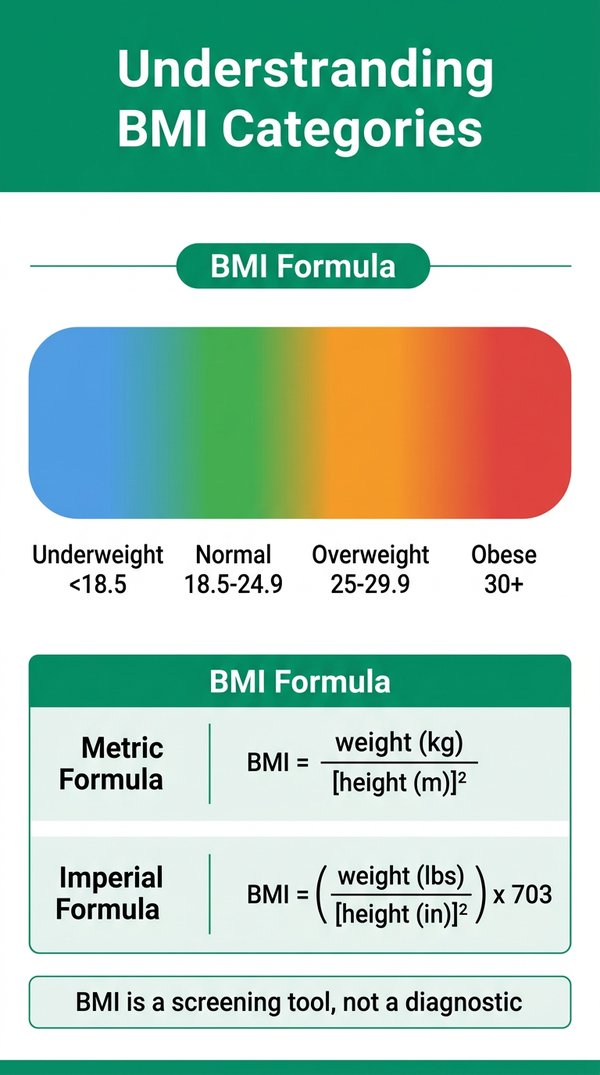
BMI Formula
BMI = weight(kg) / height(m)2
Or for imperial: BMI = (weight(lbs) / height(in)2) x 703
How to Calculate and Understand Your BMI
BMI (Body Mass Index) is a screening tool that estimates body fat based on your height and weight. While not a direct measure of body fat, it is a useful indicator of whether your weight may pose health risks.
BMI Categories for Adults:
- Underweight: BMI less than 18.5
- Normal weight: BMI 18.5 - 24.9
- Overweight: BMI 25.0 - 29.9
- Obese: BMI 30.0 and above
Note: BMI does not distinguish between muscle and fat mass. Athletes, pregnant women, and elderly individuals may get misleading results. Always consult a healthcare professional for a complete health assessment.
Complete Guide to Understanding BMI and Your Health
What Is Body Mass Index (BMI)?
Body Mass Index (BMI) is a screening tool developed by Belgian mathematician Adolphe Quetelet in the 1830s. It estimates body fat based on your weight and height, providing a simple number that helps healthcare professionals assess whether your weight may pose health risks. While BMI is not a direct measure of body fat, decades of research have shown it correlates reasonably well with more complex body composition measurements for the general population.
How Is BMI Calculated?
BMI is calculated using a straightforward mathematical formula:
BMI = weight (kg) / [height (m)]²
Or for imperial units: BMI = (weight (lbs) / [height (in)]²) × 703
The formula essentially compares your weight to your height squared. The result is a number that places you into one of several weight categories, each associated with different health risk levels.
Understanding BMI Categories
The World Health Organization (WHO) has established standard BMI categories for adults aged 20 and older. These categories are the same for both men and women:
| BMI Range | Category | Health Risk Level |
|---|---|---|
| Below 18.5 | Underweight | Malnutrition, weakened immunity |
| 18.5 - 24.9 | Normal weight | Lowest health risk |
| 25.0 - 29.9 | Overweight | Increased risk of heart disease |
| 30.0 - 34.9 | Obese (Class I) | Moderate to high risk |
| 35.0 - 39.9 | Obese (Class II) | High risk of chronic diseases |
| 40.0 and above | Obese (Class III) | Very high risk, requires medical attention |
Health Risks Associated with High BMI
A BMI above the normal range is associated with increased risk of numerous health conditions:
Cardiovascular Risks
- High blood pressure (hypertension)
- High cholesterol and triglycerides
- Coronary heart disease
- Stroke
- Heart failure
Metabolic Risks
- Type 2 diabetes
- Metabolic syndrome
- Insulin resistance
- Fatty liver disease
- Gallbladder disease
Physical Health Risks
- Osteoarthritis (joint problems)
- Sleep apnea and breathing problems
- Chronic back pain
- Certain cancers (breast, colon, endometrial)
- Kidney disease
Mental Health Risks
- Depression
- Anxiety
- Low self-esteem
- Social isolation
- Eating disorders
Limitations of BMI — When BMI Can Be Misleading
While BMI is a useful screening tool for the general population, it has important limitations:
- Muscle Mass: Athletes and bodybuilders may have high BMI despite low body fat because muscle weighs more than fat per unit volume.
- Age: Older adults tend to have more body fat than younger adults with the same BMI.
- Sex: Women generally have more body fat than men with the same BMI.
- Ethnicity: BMI categories may not apply equally across all ethnic groups. Asian populations may have health risks at lower BMI thresholds.
- Fat Distribution: BMI doesn't account for where fat is stored. Visceral fat (around the abdomen) is more dangerous than subcutaneous fat.
For a more complete health assessment, consider combining BMI with other measures such as waist circumference, body fat percentage, blood pressure, and blood work.
BMI Examples and What They Mean for Your Health
Example 1: Normal Weight — Sarah's Profile
Profile:
- Height: 5'6" (168 cm)
- Weight: 140 lbs (63.5 kg)
- Age: 32 years old
- Activity Level: Moderate
Results:
- BMI: 22.6
- Category: Normal weight
- Health Risk: Low
- Healthy Weight Range: 115-154 lbs
Key Takeaway: Sarah's BMI of 22.6 falls well within the normal range. She should focus on maintaining her current weight through regular exercise and a balanced diet rich in fruits, vegetables, lean proteins, and whole grains.
Example 2: Overweight — Mike's Journey
Profile:
- Height: 5'10" (178 cm)
- Weight: 195 lbs (88.5 kg)
- Age: 45 years old
- Activity Level: Sedentary
Results:
- BMI: 28.0
- Category: Overweight
- Health Risk: Moderate
- Healthy Weight Range: 129-174 lbs
Action Plan: Mike needs to lose 21 lbs to reach the upper end of normal BMI. A moderate calorie deficit of 500 calories/day through diet and exercise could achieve this in about 5 months. Even losing 5-10% of current weight (10-20 lbs) would significantly reduce health risks.
Example 3: Athlete — Why BMI Isn't Everything
Profile: James is a 28-year-old personal trainer, 6'0" tall, weighing 210 lbs. His BMI calculates to 28.5, which technically classifies him as "overweight." However, James has 12% body fat — well within the athletic range.
Why BMI Is Misleading Here:
- James has significant muscle mass from years of strength training
- Muscle tissue is denser than fat tissue
- His waist circumference is 32 inches (healthy range)
- Blood work shows excellent cholesterol and blood sugar levels
Key Takeaway: For athletes, bodybuilders, and very active individuals, BMI alone is not a reliable health indicator. Body fat percentage, waist circumference, and comprehensive blood work provide a much more accurate picture of health status.
Expert Tips for Achieving and Maintaining a Healthy BMI
Maintaining a healthy BMI is one of the most important things you can do for your long-term health. Here are evidence-based strategies recommended by health professionals:
1. Create a Moderate Calorie Deficit
For weight loss, aim for a 500-750 calorie daily deficit, which leads to 1-2 lbs of weight loss per week. Use our Calorie Calculator to determine your daily needs. Never drop below 1,200 calories/day (women) or 1,500 calories/day (men) without medical supervision.
2. Prioritize Protein and Fiber
Protein and fiber keep you fuller longer, reducing overall calorie intake. Aim for 0.8-1g of protein per pound of goal body weight, and 25-30g of fiber daily. Include lean meats, fish, legumes, vegetables, and whole grains in every meal.
3. Combine Cardio and Strength Training
The American Heart Association recommends 150 minutes of moderate cardio or 75 minutes of vigorous cardio per week, plus strength training at least 2 days per week. This combination burns calories, builds muscle, and boosts metabolism.
4. Track Your Progress
Weigh yourself weekly at the same time, measure your waist circumference monthly, and use our BMI calculator to track trends. People who monitor their weight regularly are more successful at both losing weight and keeping it off long-term.
5. Get Enough Sleep
Poor sleep disrupts hunger hormones (ghrelin and leptin), increasing appetite and cravings. Adults need 7-9 hours per night. Studies show that people who sleep less than 6 hours are 55% more likely to be obese.
6. Manage Stress Effectively
Chronic stress raises cortisol levels, which promotes fat storage — especially around the abdomen. Practice stress management through meditation, deep breathing, yoga, or hobbies you enjoy. Emotional eating undermines weight loss efforts.
Pro Tip: Losing just 5-10% of your current body weight can dramatically improve health markers — reducing blood pressure, cholesterol, and blood sugar levels. Don't aim for perfection; aim for progress. A 10-lb loss for a 200-lb person is a significant health improvement.
Common BMI Myths Debunked
Myth: "BMI is useless because it doesn't measure body fat"
Fact: While BMI doesn't directly measure body fat, it correlates well with more precise measures for most people. It's designed as a population-level screening tool, not a diagnostic test. For individual assessment, combine BMI with waist measurements, body fat percentage, and blood work for a complete picture.
Myth: "A BMI of 25 is perfectly healthy"
Fact: A BMI of 25 is the threshold for "overweight." While being slightly above normal weight doesn't mean you're unhealthy, research shows that health risks begin to increase at BMI 25+. The "overweight paradox" (where slightly overweight people live longer) is controversial and may be explained by other factors like fitness level and muscle mass.
Myth: "If I'm muscular, BMI doesn't apply to me at all"
Fact: While BMI can misclassify very muscular individuals, it still has value. If your BMI is high but you're athletic, use additional measures — body fat percentage (should be 6-17% for men, 14-24% for women), waist circumference (below 40" for men, 35" for women), and cardiovascular fitness tests.
Myth: "I should aim for the lowest possible BMI"
Fact: A BMI below 18.5 is classified as underweight and carries its own health risks, including weakened immunity, fertility problems, and osteoporosis. The goal is a BMI in the 18.5-24.9 range, not the lowest number possible. Focus on healthy habits, not extreme weight loss.
Myth: "BMI standards are the same worldwide"
Fact: Some countries use different BMI thresholds. For example, Japan considers BMI above 25 as obese, and China uses 24 as the overweight threshold. Research suggests that Asian populations may face increased health risks at lower BMI levels due to differences in body composition and fat distribution.
Myth: "BMI changes don't matter if my weight is stable"
Fact: BMI changes can reflect important shifts in body composition. If you're losing fat but gaining muscle, your BMI might stay the same while your health improves dramatically. This is why tracking waist circumference, body fat percentage, and how you feel is just as important as tracking BMI.
Frequently Asked Questions
What is a healthy BMI range?
A healthy BMI range for adults is 18.5 to 24.9. Below 18.5 is considered underweight, 25-29.9 is overweight, and 30 or above is classified as obese. These ranges are the same for men and women, but BMI does not account for muscle mass, bone density, or fat distribution.
Is BMI accurate for athletes and muscular people?
BMI can be misleading for athletes and muscular individuals because it does not distinguish between muscle and fat. A muscular person may have a high BMI but low body fat. For these individuals, body fat percentage or waist-to-hip ratio may be more accurate health indicators.
How is BMI calculated for children?
For children and teens (ages 2-19), BMI is calculated the same way but interpreted differently using age- and sex-specific percentile charts. A child's BMI is compared to other children of the same age and sex. The 85th-95th percentile is considered overweight, and above the 95th percentile is obese.
What is the difference between BMI and body fat percentage?
BMI is a simple ratio of weight to height that estimates whether your weight is appropriate for your height. Body fat percentage directly measures how much of your body is composed of fat. Body fat percentage is more accurate for assessing health but requires special tools to measure.
Can BMI be used during pregnancy?
BMI is not a useful measure during pregnancy because weight gain is expected and healthy. Pre-pregnancy BMI can help determine recommended weight gain during pregnancy, but BMI calculations during pregnancy are not meaningful. Consult your healthcare provider for pregnancy-specific weight guidance.
What is a healthy waist circumference?
Waist circumference is an important indicator of visceral fat. For men, a waist measurement below 40 inches (102 cm) is recommended. For women, below 35 inches (88 cm) is ideal. Excess abdominal fat increases the risk of heart disease, type 2 diabetes, and metabolic syndrome, even if your BMI is normal.
How can I lower my BMI safely?
Aim for gradual weight loss of 1-2 lbs per week through a moderate calorie deficit (500-750 calories/day). Combine a balanced diet rich in whole foods with regular exercise (150 minutes of cardio + 2 days of strength training weekly). Avoid crash diets, which are unsustainable and can slow your metabolism.
Does BMI change with age?
The BMI formula doesn't change with age, but body composition does. As people age, they tend to lose muscle mass and gain fat, even at the same weight. Some research suggests that a slightly higher BMI (25-27) may be protective for adults over 65, though this remains debated among health professionals.
What BMI do models and celebrities have?
Fashion models often have BMIs in the 16-18 range, which is classified as underweight and unhealthy. It's important not to use celebrity or model weights as health goals. A BMI below 18.5 carries serious health risks including weakened immunity, hormonal imbalances, and bone density loss. Focus on health, not appearance.
How often should I check my BMI?
Check your BMI every 2-4 weeks if you're actively trying to lose or gain weight. If you're maintaining your weight, monthly checks are sufficient. Daily fluctuations are normal and not meaningful — focus on trends over weeks and months rather than individual readings. Combine BMI tracking with waist measurements and how your clothes fit.